Castor Wax in Eco-Friendly Personal Care Products
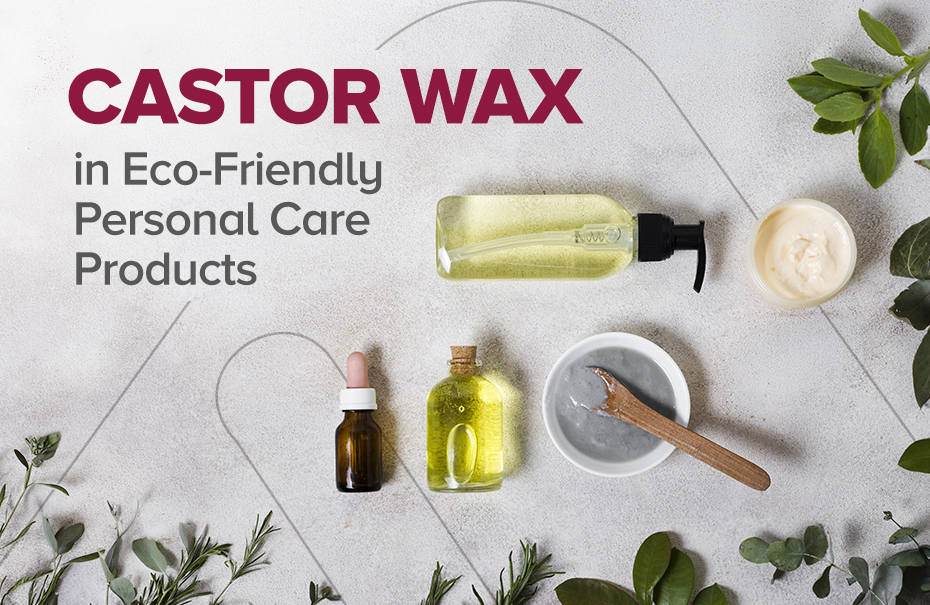
Effective personal care products need to balance performance, texture, stability, and ingredient selection. Castor wax is a plant-based component that can contribute to accomplishing objectives. It is useful for brands that are looking for plant-based ingredients for products like lipsticks, lip balms, or creams, among others, because of its texture and structure.
Castor wax is a product obtained by hydrogenating castor oil, a process that changes the fatty acids of the oil and turns it into a wax-like product. Due to its origin and properties, it is also valuable for formulations, consistency, structure and stability.
Let’s know why castor wax is an essential component for personal care products.
What is Castor Wax?
Castor wax is produced through hydrogenating castor oil. During the hydrogenation of castor oil, the double bonds in the fatty acids are saturated, which makes it more stable and increases its melting point.
This provides a firm wax that may be used in personal care formulations to provide structure, consistency and stability. This is especially beneficial because liquid castor oil and castor wax have different formulation roles.
Castor oil is emollient and conditioning while castor wax is structural. Castor wax is a vegetable source that is not only a renewable source, but also has good technical performance, and is used in personal care products.
Why is Castor Wax Relevant to Eco-Friendly Personal Care?
The modern personal care industry is moving beyond the simple question of whether an ingredient is natural. Today’s formulators are more focused on assessing ingredients by their functionality and formulation efficiency.
Castor wax can help with this transition in a number of ways.
1. A plant-derived alternative for formulation design
Castor oil is derived from castor beans, and hydrogenated castor oil retains its castor-derived origin while taking on wax-like properties.
This is another material to consider when researching alternatives to some traditional wax systems for brands creating formulations around plant-derived ingredients.
2. Strong structural functionality
A sustainable ingredient still needs to perform. In cases where the hardness, stability, or consistency is not adequate, added ingredients or processing steps are required.
Castor wax provides a variety of useful formulation properties such as:
- Consistency and binding
- Viscosity control
- Emollient and skin-conditioning support
- Structure and hardness of solid formulations
- Stability enhancement in appropriate formulations
- Product smoothness enhancement
Some key properties of hydrogenated castor oil is that it is a binder, an emollient, and a skin conditioner.
Where is Castor Wax Used in Eco-Friendly Personal Care Products?
The market for castor wax application can be segmented into a number of categories of personal care and cosmetics. It can offer structure and also add desirable sensory properties that make it suitable for traditional and new product formats.
1. Lipsticks, Balms and Colour Cosmetics
For solid colour cosmetics, control of hardness, payoff, spreadability and temperature resistance are critical.
Castor wax can be used to add structure to products like:
- Lipsticks
- Lip balms
- Lip gloss formulations
- Solid makeup products
- Certain stick-format cosmetics
Castor wax applications help maintain product integrity and support smooth application.
2. Skin-care Formulations
Additionally, castor wax can be incorporated into creams, balms, ointments, and other preparations that need consistency and texture.
It has occlusive and conditioning properties that can help to retain moisture and softness in the skin, which can be beneficial for formulations such as moisturizers.
This is especially relevant for more premium, non-aqueous or solid personal care products.
3. Hair-care Products
Hair products often need ingredients to give texture, conditioning, consistency or controlled application.
Hydrogenated castor oil might thus be used in certain hair-care products where a wax-like ingredient is needed. Castor wax can be incorporated into selected personal care formulations, including certain hair care products, where it contributes to product texture, consistency, and stability.
4. Deodorants and Solid Personal Care
The shift toward sticks and solid formats has created greater interest in functional waxes.
Castor wax may be used to give structure to some deodorant and solid personal care products and its origin fits the naturally oriented ingredient profile of these products.
Why Formulators Should Look Beyond the “Natural” Label
It is easy to think that once the synthetic product is replaced by a plant-based equivalent, it becomes a sustainable product. In reality, formulation sustainability is much more complicated.
It is better to consider several parameters of an ingredient, such as source, processing, performance, quantity required, and product life cycle.
Castor wax becomes particularly valuable when it performs its intended function effectively within a personal care formulation. If one ingredient can serve more than one purpose, such as structure, binding and viscosity control, it can assist formulators in avoiding complex systems.
Sustainability considerations should be taken into account for formulation decisions but not as the only criteria; other factors such as ingredient compatibility, specifications, and product design are also important.
The Growing Demand for More Transparent Beauty Ingredients
When it comes to personal care products, consumers are also more aware of what they’re putting on their skin. More than 50% of all engaged Beauty & Personal Care and Household shoppers look at labels for details on recyclability, on a regular basis.
It is an important opportunity for both the ingredient manufacturers and personal care brands. Companies can tell consumers why the formulation decision was made, rather than simply stating that the product is ‘green’:
- Where an ingredient is sourced
- What it does
- How it is responsibly sourced
- How it contributes to the overall design of a formulation
For manufacturers considering castor as a source of ingredients, this translates to consistency and technical documentation being as important as its source.
It is possible to accomplish this balance with the right supplier. The right supplier can assist personal care formulators to use castor wax safely and repeatedly in commercial formulations by providing consistent quality, the correct specification, technical support and reliable supply.
The experience of companies such as Ambuja Solvex in castor derivatives highlights how specialised knowledge in this field can support applications across various industries, including personal care.
Conclusion
This increased demand for castor wax in personal care products reflects the broader shift in beauty formulation, as consumers increasingly seek products that are environmentally responsible, effective, safe, and consistent, supported by clear and transparent ingredient information.
In personal care, castor oil wax offers beneficial structure and functionality for lipsticks, balms, deodorants and some skin and hair care products. Ambuja Solvex has experience in castor oil and its derivatives to assist customers in assessing the raw material for various applications in personal care and cosmetic products.
| Explore castor wax for high-performance personal care formulations. |
FAQs
1. What is castor wax?
Castor wax is a hydrogenated castor oil, a hard and waxy derivative of castor oil, which has a high melting point and is stable.
2. What is the use of castor wax in cosmetics?
It can be incorporated into lipsticks, balms, deodorants, creams, and other personal care formulations where it helps provide structure, binding, texture, or viscosity control.
3. Why is castor wax considered for eco-friendly formulations?
Castor wax comes from the castor plant and can be used in formulations containing plant-based ingredients. The multifunctional properties can also be used for personal care products to meet certain technical specifications, such as structure, texture and stability.
More Insights From The Castor World