Refined Castor Oil Manufacturer: Quality & Manufacturing Standards
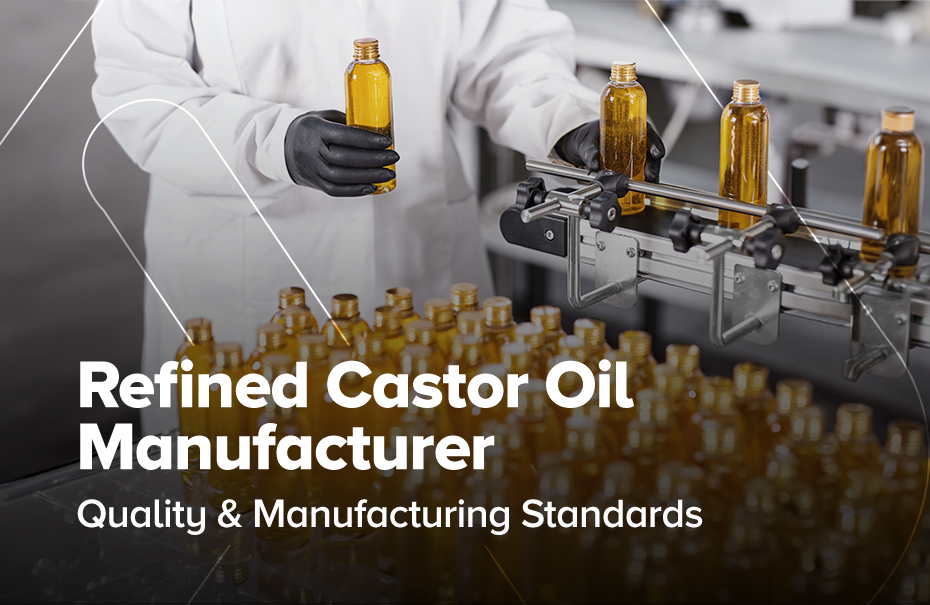
Why is castor oil suitable for satisfying the needs of industries and the pharmaceutical sector? The answer lies not only in the source material, but also in the purification process, quality checks, and consistent results.
The different industrial and pharmaceutical uses of castor oil require different grades. Thus, selecting a reliable refined castor oil supplier is an important step in the procurement process.
When you understand how the product is made, its specifications, and the quality assurance process, it becomes easy to know the type of castor oil and how to reduce the risks associated with its production.
What is Refined Castor Oil?
Refined castor oil has undergone processes in order to remove contaminants and components that don’t suit certain purposes. The process of purification involves, but is not limited to, filtering and bleaching.
It is naturally rich in ricinoleic acid, which gives it a remarkable viscosity, useful in several industries.
But refining does not make it suitable for all applications. The final product must comply with the specifications necessary for its intended application, including in cases of pharmaceutical or regulated applications.
Why Manufacturing Standards Matter
Industrial standards are essential for the assessment of the grade of the product and its suitability for the application. While looking for refined castor oil, a buyer must consider the following points:
- Purity and cleanliness: Assess how pure the oil is.
- Acid value: Used for evaluating the total free acid content.
- Moisture content: An important factor for assessing the stability of quality and storage.
- Colour and appearance: Used in case of specific visual requirements.
- Viscosity: Affects the handling, mixing, and application.
- Grade conformance: Pharmaceutical uses may demand conformance to some pharmacopoeial requirements.
The suitable ranges for these parameters depend on grade and application. An experienced supplier can provide the required information rather than vague assurances.
How is Refined Castor Oil Manufactured?
The appearance, quality, and suitability of the final oil depend upon the making process. While this can be done in various ways, there are several steps that are usually followed.
1. Raw Material Selection
Consistent castor oil feedstock is the basis for good refining. A good base can be obtained through proper inspections of your production needs as well as good purchasing practices.
2. Filtration
Before the castor oil is treated further, the water filtration process is carried out, and the unwanted substances and suspended solids are removed from it.
3. Refining and Bleaching
Refining reduces selected impurities, while bleaching can help improve colour. Depending on the process, suitable refining agents may be used to obtain the required specifications.
4. Quality Testing
The final product is evaluated using its relevant specifications. Depending on the grade, various parameters such as appearance, acid value, moisture, viscosity, should be checked.
5. Storage and Packaging
Contamination of the oil during handling and transport is avoided due to proper packaging and controlled storage. Packaging has to meet the requirements of both the product and the buyer.
All these stages go together and make it possible for the manufacturers to obtain the quality required.
Understanding Refined Castor Oil DAB-10, USP and EP Grades
1. Refined Castor Oil DAB-10
DAB is the German pharmaceutical compendium, Deutsches Arzneibuch. Refined castor oil DAB 10 is suitable for buyers requiring products that meet the applicable DAB 10 specifications.
It can be used in numerous pharmaceutical products, personal care products, cosmetics, and industrial applications, depending on its properties and suitability.
It is still important for buyers to check certain parameters, test results, and whether the samples meet the requirements before purchasing.
2. USP Grade Castor Oil
USP stands for the United States Pharmacopeia. Castor oil must conform to the requirements of the applicable USP–NF monograph for USP-grade castor oil.
It could be used in pharmacy and when compliance with the corresponding US Pharmacopoeia standard is needed. It is necessary to check the monograph specifications as well as ask for the supporting quality documents.
3. Refined Castor Oil EP Grade
EP is a term used for the European Pharmacopoeia. Refined castor oil EP grade is used in applications that demand compliance with the requirements in the European Pharmacopoeia.
Manufacturers should review the applicable monograph, product specifications, certificates of analysis, and process-specific requirements.
Note: DAB 10, USP, and EP are distinct standards and should not be considered interchangeable. You must select the grade depending on the place of application or market and specification.
Applications of Refined Castor Oil Across Industries
- Pharmaceuticals and personal care: Select a castor oil grade that meets the specific quality and regulatory requirements of the intended application.
- Paints, inks, and varnishes: Certain technical features of castor oil can be useful in paints, inks, and varnishes.
- Lubricants and speciality chemicals: Castor oil’s fatty acid composition makes it suitable for certain speciality chemical formulations and lubricant applications.
- Textiles and coatings: Refined castor oil may be used as a component in certain textile chemicals and speciality coatings.
These applications highlight the importance of evaluating refined castor oil suppliers based on grade suitability, technical specifications, and batch consistency, while also considering price and overall value.
How to Choose a Reliable Refined Castor Oil Manufacturer
When selecting a provider, it is necessary to consider the product specifications and documentation as well as the service capability.
The following factors should be considered before placing an order:
- Clear specifications: Make sure to check the relevant grades.
- Quality documentation: Ask the supplier for the specification sheet and Safety Data Sheets (SDSs).
- Batch consistency: Enquire about the procedure to monitor quality variations.
- Application knowledge: Make sure that the supplier can help you with understanding the appropriate grade.
- Lead time: Evaluate the reliability of supplies, packaging, and order fulfilment.
- Traceability: Make sure that batch identification and documentation are present.
Buyers should distinguish between compliance with applicable standards and formal certification, verifying the validity, scope, and issuing authority of any certifications or regulatory claims.
The Indian Castor Industry: The Importance of Sourcing Reliability
Supplier selection is crucial for companies buying castor oil and its derivatives, as India has a significant role in the global castor supply chain. (Source)
Although India has an abundant supply of raw materials, manufacturers must continually improve their production processes through rigorous testing and material refinement.
Conclusion
When selecting the right refined castor oil manufacturer, the product itself is not enough; you need to consider its quality, specifications, and suitability for the intended use.
Manufacturers must implement appropriate quality checks and obtain the required certifications for each castor oil grade, including DAB 10, USP, and EP.
Ambuja Solvex supplies refined castor oil DAB-10 and refined castor oil EP grade, and a variety of castor oil products and derivatives.
| Check out the full range of refined castor oil products. |
FAQs
1. What does a refined castor oil manufacturer do?
A refined castor oil manufacturer purifies castor oil and enhances the desired properties. The product is tested against the specifications that are appropriate to the use.
2. What is refined castor oil DAB-10 used for?
It is used in special applications that need to meet the requirements of the relevant DAB-10 specification. The buyer is advised to check its appropriateness for their intended application.
3. Is castor oil USP grade and EP grade the same?
No. USP and EP are different pharmacopoeial standards that have their own requirements. Grades depend on the intended use and regulatory requirements.
4. How to check the quality of refined castor oil before buying?
Review product specifications and test results to verify grade compliance, and examine batch-specific certificates and records to establish traceability.