How to Choose Reliable Castor Oil Suppliers for Bulk Orders
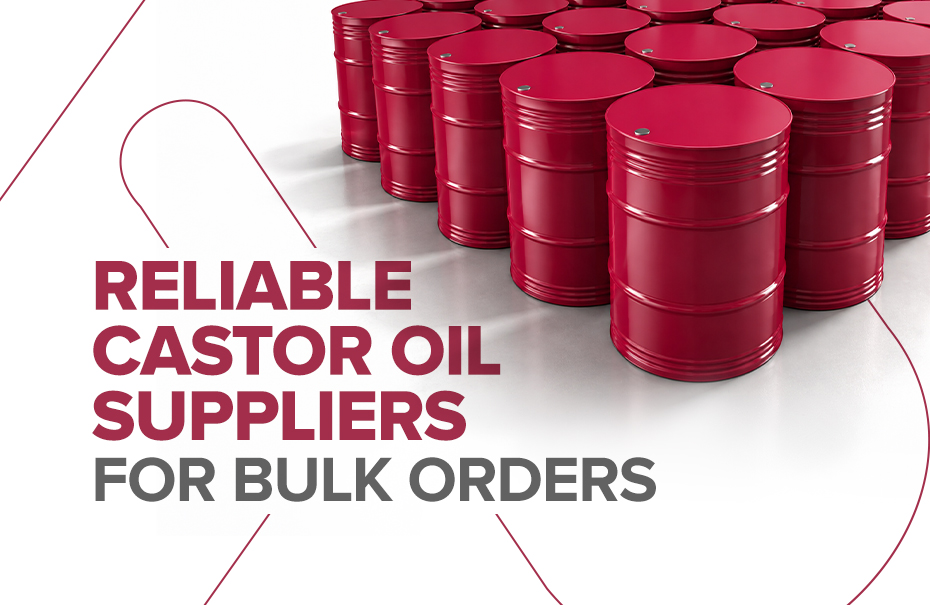
Purchasing castor oil in bulk may seem a straightforward process: ask for quotes, read the specs, locate a supplier, and place a purchase. When purchasing castor oil in hundreds of kilograms or several tonnes, selecting the right supplier becomes a critical business decision. A reliable supplier helps maintain product quality, ensure consistent production, meet compliance requirements, and fulfil customer orders on time.
The issue is that there are different types of bulk suppliers. Some are focused exclusively on trading, and others have their own manufacturing, processing, testing, and R&D. For industrial buyers, the difference is one that matters.
Key Factors to Consider When Choosing a Reliable Castor Oil Supplier
1. Start by Defining Your Castor Oil Requirements
Before you start comparing suppliers, make sure to know what kind of castor oil your business requires. Castor oil is used in pharmaceuticals, cosmetics, personal care, lubricants, coatings, chemical processing, and more.
When approaching potential castor oil suppliers for bulk orders, clarify:
- Required grade and specification
- Intended application
- The quantity and frequency of orders required
- Packaging and/or bulk transport specifications
- Testing and documentation requirements
- Delivery location and expected lead time
2. Review Supplier’s Quality Control System
Product quality depends on how effectively a supplier manages every stage of production. Rather than relying solely on product descriptions and marketing claims, evaluate their procedures for sourcing raw materials, processing, testing, storage, and delivery.
Acid value, hydroxyl value, iodine value, moisture content, viscosity, specific gravity, colour, or fatty acid content can be monitored depending on the grade and application.
Documentation is also important. A reliable supplier should be able to give the following technical information:
- Certificate of Analysis (COA)
- Product Data Sheet (PDS)
- Safety Data Sheet (SDS/MSDS)
- Applicable certifications
- Batch or lot information
- Relevant regulatory documentation
The most important thing is that the supplier must have the ability to show consistency between what is promised and what is delivered.
3. Know the Manufacturing Capacity of Suppliers for Bulk Supply
A supplier may fulfil a single large order successfully but struggle to meet recurring bulk requirements. If your business depends on regular deliveries, assess the manufacturer’s production capacity and ability to maintain consistent quality across every order.
Ask questions like:
- Will the supplier be able to meet my monthly requirement?
- Can it accommodate an increase in volume?
- Does it have sufficient storage?
- Does it have the ability to reproduce the specifications in more than one batch?
Manufacturers that have processing infrastructure, analytical facilities, and R&D facilities have more control over the products and processes. For instance, Ambuja Solvex has separate R&D and pilot plant facilities, multiple processing lines, analytical instruments, and its own container stuffing and palletisation facilities.
The goal is to establish a reliable long-term partnership that meets your current order requirements and supports your business’s future demand.
4. Check Whether the Product Portfolio Matches Your Requirements
The technical characteristics of a supplier can be better understood by examining their product line.
If your business requires standard refined castor oil, the evaluation process may be relatively straightforward. However, pharmaceutical-grade castor oil and specialised derivatives, such as hydrogenated castor oil, demand stricter specifications and more detailed supplier assessments.
If you are considering a supplier of hydrogenated castor oil, one of the primary things you need to figure out is whether the supplier can perform the hydrogenation process or merely resell the product.
Hydrogenated castor oil is produced by hydrogenating castor oil to form a solid, wax-like material used in applications such as cosmetics, pharmaceutical formulations, lubricants, and protective coatings. Available grades vary in their properties and specifications, depending on the intended application.
When your requirements change, or you need to create a bespoke specification, a technically capable manufacturer can be very useful.
5. Pharmaceutical Buyers Should Apply Stricter Supplier Checks
Selecting castor oil suppliers for pharmaceutical applications requires a more rigorous evaluation of product quality, grade specifications, and regulatory compliance.
For pharmaceutical manufacturers, commercial considerations are not the only reason for choosing a supplier. The consistency, documentation, testing, manufacturing controls, product purity, and grade become important factors.
For example, pharmaceutical-grade castor oil may be manufactured to meet the requirements of specific pharmacopeias, such as BP, USP–NF, EP, or JP, depending on the product’s intended use and applicable standards. Recognised pharmacopoeial grades of pharmaceutical-grade hydrogenated castor oil are also available.
Pharmaceutical buyers should check:
- Applicable pharmacopoeial specification
- Batch-wise testing and COA availability
- Manufacturing and quality-control procedures.
- Traceability of supplied material
- Relevant certifications and regulatory documentation
- Ability to maintain specification across repeat orders
For pharmaceutical procurement, the supplier’s ability to maintain consistent product quality across every order is just as important as meeting initial specifications.
6. Compare Batch-to-Batch Consistency
Consistency is a critical factor in bulk castor oil sourcing, yet it is often overlooked. Even if an initial sample meets your specifications, subsequent batches may vary in quality, composition, or performance, potentially disrupting production. Small changes can disrupt a controlled formulation or manufacturing process.
So don’t consider a supplier based on just one COA. If possible, analyse several batches and compare important parameters. Enquire about how the manufacturer manages batch traceability and what they do in case of a deviation.
A good supplier should be able to meet the following:
- Batch identification
- Quality testing
- Retention samples
- Documentation
- Complaint handling
- Corrective and preventive actions
7. Don’t Make Price the Only Deciding Factor
In bulk procurement, price is a factor, of course. But the lowest quoted price does not always translate into the greatest cost savings. A supplier selling at a lower price but provides inconsistent material. If that results in lost production time, there may be batches rejected due to testing, reformulation, or delays in customer deliveries, and the savings are lost.
Price is an important consideration when purchasing castor oil in bulk, but the lowest quoted price does not always translate into the greatest cost savings. A supplier offering cheaper material may deliver inconsistent quality, leading to production downtime, rejected batches, additional testing, reformulation costs, or delayed customer orders. These expenses can quickly outweigh the initial savings.
A better procurement equation is:
Total Value = Product Quality + Consistency + Reliability + Technical Support + Logistics + Competitive Pricing
A supplier offering stronger quality assurance and reliable delivery may provide greater long-term value, even at a slightly higher price.
8. Check Supplier’s Technical and Manufacturing Depth
Strong relationships with suppliers depend on more than purchase orders. Manufacturers need suppliers who understand their technical requirements and consistently deliver materials that meet the required specifications.
This is especially important when purchasing castor oil products with greater specifications.
Look for evidence of:
- In-house R&D
- Pilot-plant capabilities
- Analytical testing
- Modern processing equipment
- Multiple reaction capabilities
- Experienced technical teams
- Continuous process improvement
For instance, Ambuja Solvex has processing capabilities that include hydrogenation, dehydration, esterification, distillation, neutralisation, and bleaching. The company also operates an in-house R&D centre and a pilot plant to support product development and process optimisation.
Evaluate the Strength and Reliability of the Supply Market
India’s castor oil export market provides useful context for bulk sourcing decisions. The exports of castor oil and its fractions other than edible grade reached US$1,059.05 million in FY 2024–25, up 7.09% from US$988.95 million in FY 2023–24. However, market growth alone does not establish supplier reliability. Buyers should assess each supplier’s product consistency, quality controls, production capacity, and ability to meet delivery commitments.
The real challenge is in identifying a supplier that can meet not only the other needs, quality, documentation, technical expertise, and reliable delivery.
Conclusion
Price is not the only factor when sourcing castor oil in bulk. It should be based on quality systems, manufacturing capacity, and long-term reliability.
For long-term sourcing, consider suppliers such as Ambuja Solvex, which combines castor oil derivative manufacturing capabilities with in-house R&D and analytical facilities to support product development and quality control.
In the end, the right supplier is not just the low-cost supplier of castor oil. It’s the one that can provide you the right product, at the right specification, in the right quantity, with the proper documentation and reliability your business needs.
| Looking for a reliable castor oil supply partner? |
FAQs
1. What should I check when choosing castor oil suppliers for bulk orders?
Assess product specifications, quality control systems, COA, manufacturing capacity, batch consistency, documentation, logistics, and delivery reliability prior to ordering.
2. How to find good castor oil suppliers for pharmaceutical companies?
Check the necessity of pharmacopoeial grade and the quality testing methods, certificates, batch documentation, traceability, and quality control of the supplier.
3. What should I look for in a supplier of hydrogenated castor oil?
Evaluate their hydrogenation capacity, supply availability, technical information, testing, and experience in hydrogenation for their target application.
4. Why should businesses consider castor oil suppliers in India?
India has a robust castor oil manufacturing and export ecosystem with significant export volumes to the world and infrastructure to supply castor oil in bulk quantities overseas.
More Insights From The Castor World