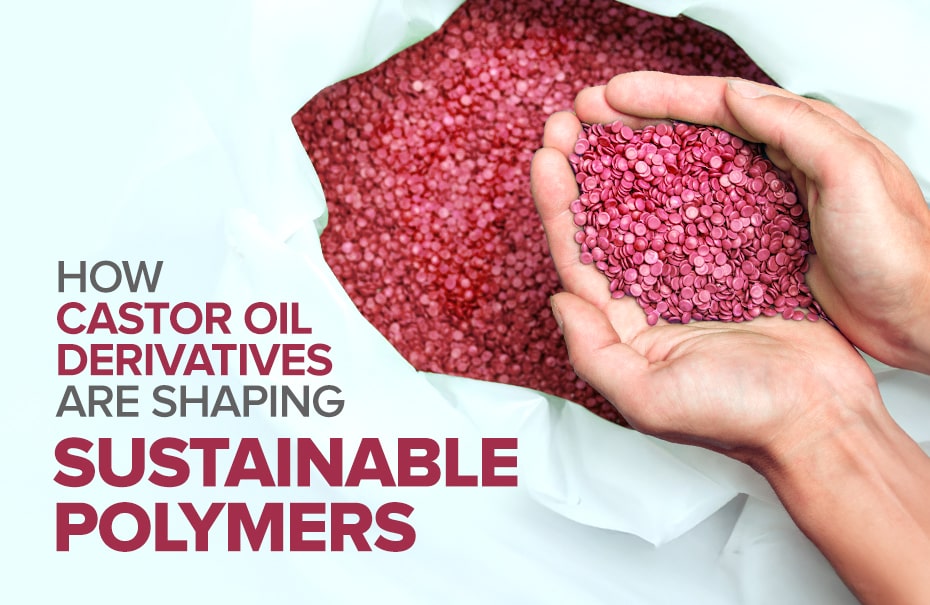
How Castor Oil Derivatives Are Shaping Sustainable Polymers
Consider a global materials firm coming under increasing pressure due to written regulations regarding decreased emissions, OEM clients that want bio-based materials, and consumers that are demanding greener products. The question of how we can switch to sustainable polymers without adding costs or without compromising performance continues to arise in the boardroom.
The same situation is being replicated in industries nowadays, and surprisingly, the solution lies in a crop that is resistant to drought and is being cultivated in large quantities in the dry belts of India. The global business community is currently relying on Castor Oil Derivatives, which were originally viewed as a niche industrial input, as a foundation of scalable, high-performance, and climate-friendly polymers.
The seeds of castor, which are naturally rich in ricinoleic acid, provide a chemical composition that is unparalleled by other vegetable oils. Not only do they help cut the reliance on petroleum feedstocks, but they also enable Low-Cost Biopolymer Production, a breakthrough that makes sustainable materials commercially viable when used in B2B brands. As India is also at the forefront of cultivation and innovation across the globe, Castor Oil Manufacturers in India are the new rightful partners for companies that are reconsidering their material strategy.
This blog will discuss how the castor-based derivatives have become an essential part of the next generation of sustainable polymers.
Castor Oil as a Renewable Feedstock of High Value.
Among all natural oils, castor oil is one that is industrially versatile. The percentage of hydroxylated fatty acids is high, and thus, the acids are highly reactive and chemically versatile. Hence, they play a significant role in the manufacturing of polymers.
Some reasons castor oil is superior with regard to polymer development:
- Higher hydroxyl content allows chemical modification.
- Stable supply and quality because of the leading ecosystem of cultivation in India.
- Non-edible crop, or it does not compete with the food supply chain.
Due to these benefits, castor oil has continuously been the alternative to replace fossil-generated polyols, diacids, and plasticizers, as well as specialty monomers.
This change can be seen in many sectors, polymers made by using castor products are being incorporated by the automotive sector, packaging sector, and also consumer goods sector, electronics sector, and textiles sector as substitutes to petroleum feedstock without performance loss.
The Chemistry Behind Castor Oil Derivatives in Polymers
The distinct molecular structure of castor oil allows it to be transformed into several useful intermediates, which are used in the manufacture of polymers; these include:
- Sebacic Acid, biodegradable plastics, polyamides (Nylon 6,10; Nylon 10,10), and aerospace-grade materials.
- 2-Octanol derivatives and 2-octanol derivatives, necessary in plasticizers and lubricants.
- Polyurethane foams, adhesives, coatings, and elastomers are modified with polyols in place of petroleum-based polyols.
- Hydrogenated Castor Oil (HCO) enhances the thermal stability of polymer mixtures.
These derivatives are not only useful in enhancing the performance of the polymers, but also in the production of bio-based and carbon-saving materials. They are more heat resistant, more dimensionally stable, and more mechanically strong, which are important needs in engineering polymers.
When incorporated in the biopolymer production, these derivatives contribute to the reduction of carbon emissions and energy usage dramatically. Polyamides based on castor, such as those, in fact, tend to be at least 60 percent less carbon-intensive than their petroleum counterparts.
Selecting Low-Cost Biopolymers
Economic feasibility has always been a challenge in sustainable materials. Several biopolymers are expensive and are not widely adopted. This barrier, however, is being overcome with castor oil.
The reason to use castor oil-derived derivatives in the production of low-cost biopolymers:
- Rich and strong crop that needs little irrigation and grows in dry areas, thereby reducing the costs of raw materials.
- Indian manufacturers have created an efficient processing chain that guarantees competitive pricing.
- The conversion rate is high, thus resulting in low waste in downstream chemical transformations.
- Positive chemical reactivity lowers the complexity and energy requirements in manufacturing.
The outcome is a bio-feedstock that balances sustainability and scalability, enabling renewable polymers to be economically viable in mass markets.
For example, the biopolyamides and polyurethanes made with castor oil are finding increased application in the automotive interiors, consumer appliances, footwear, and industrial markets, historically dominated by petro-polymers.
Industry Applications Redefining Polymers
Industries are now able to use greener, stronger, and more versatile polymers with the help of castor oil derivatives. The most influential use cases are listed below.
#1 Automotive & Mobility
Sebacic acid generates bio-polyamides that are utilized instead of metal and petroleum plastics in fuel lines, under hood components, and light structural components.
Besides reducing the weight of a vehicle, the polymers also enhance the life span of a vehicle, and thus help the manufacturer to meet the fuel-efficiency and emission standards.
#2 Textiles & Fashion
Sustainable fashion has driven the need to use bio-based polyesters and nylons. Castor-based nylon is flexible, resistant to sweat, and comfortable to wear long-term, which fits the description of performance apparel and outdoor garments.
#3 Electronics
Castor polyurethanes and polyamides are used to offer both heat resistance and flame retardancy and are therefore applicable in circuit cases, protective finishes, and insulation.
#4 Packaging & Consumer Goods
Castor oil polymers are biodegradable and recyclable and are finding their way into the packaging industry as a result of their strength, resistance to chemicals, and their compatibility with compostable blends.
#5 Healthcare and Pharmaceuticals
Biocompatible castor derivatives that have been refined into medical-grade polymers are suitable as a drug delivery system, implants, and dermatological formulations.
The Future: Castor-Based Polymers as a Foundation of Sustainable Materials
Renewability, recyclability, and carbon-neutrality are the future of the polymer industry. Moreover, the world markets in the castor oil-derived biopolymer will reach USD 1,280.5 million in 2025. These numbers reflect the growing need for polymer in manufacturers who are more actively searching for alternative bio-based and cost-effective materials.
Some of the trends that define the coming decade involve:
- Fast development of castor-based nylons in automobile lightweighting.
- More R&D in biodegradable castor-based polyesters.
- Green building materials adopt the use of castor polyols.
- Increasing interest in non-GMO non-food biomass feedstocks.
- Firms transitioning to mass-scale Low-Cost Biopolymer Production to circular economies.
With the world moving fast to achieve the net-zero objectives, castor oil derivatives will be an undeniable part of this process of remaking sustainable polymer manufacturing.
Conclusion
Castor oil derivatives are not merely an alternative to petrochemicals, but they are reconsidering the material science world with renewable power, low cost, and performance versatility. As India sets the pace in the world of production and innovation, trusted manufacturers are here to assist industries that are moving to bio-based polymers without affecting quality and cost effectiveness.
Ambuja Solvex is one of the progressive Castor Oil Manufacturers in India, which has been contributing towards this revolution by providing high-quality derivatives to enable businesses to become sustainable on a large scale.
| Replace petro-based inputs with high-purity castor derivatives. |
FAQs
1. What are the applications of castor oil derivatives in sustainable polymers?
They can be substituted with petroleum-based feedstock as renewable feedstock to polyamides and plasticizers in the production of polymers.
2. What is the importance of India in the manufacturing of castor oil-based polymers?
India has a sound agricultural foundation with a large processing capacity. This allows it to become the world leader of castor-based materials.
3. Are castor-based polymers biodegradable?
Some polyesters, together with specialty biopolymers, are castor-based polymers, which can be biodegraded depending on their chemical composition.
4. Why should castor oil be the best alternative to be used in making the low-cost biopolymers?
Its high availability, higher conversion ratio, and low resource needs contribute to the low total cost of manufacturing sustainable polymers.
More Insights From The Castor World