Castor Oil Grades Explained: BP, USP, Industrial & Cosmetic
One of the most used plant-based oils today (in the industries, be it in the pharmaceutical and cosmetics market or in lubricants and coatings) is castor oil. Castor oil is a seed oil derived from the seeds of the Ricinus communis plant and is prized due to its unusual chemical composition, notably its rich content of ricinoleic acid. This gives it fine lubricating properties, moisturising properties and stabilising properties.
But not every castor oil is created equal. There are many Castor Oil Grades available in the market, all with particular industrial or regulatory needs. These grades are critical to manufacturing and formulating professionals who need purity and consistency in the raw material that they use.
In this guide, let’s understand the key castor oil grades used around the world.
Understanding Castor Oil Grades
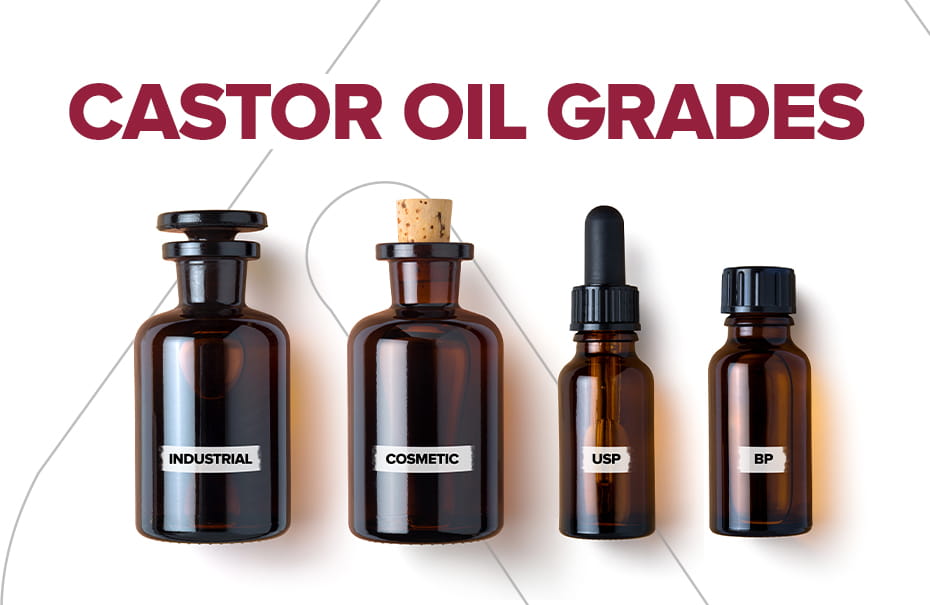
Castor Oil Grades are used to describe the different grades of castor oil depending on the level of refinement along with purity and intended use. Such grades are usually measured by international pharmacopoeia standards or industrial specifications.
Most popular grades:
- Pharmaceutical Grade (BP/USP)
- Cosmetic Grade
- Industrial Grade
All grades are processed differently and tested through various quality tests to achieve the required standards.
When speaking of those manufacturers that purchase castor oil, the quality of the right grade directly influences the product safety and performance.
Pharmaceutical Grade (BP/USP) Castor Oil
One of the highest levels of purity categories falls into Pharmaceutical Grade (BP/USP) castor oil. The grades are prepared based on pharmacopoeial standards set by:
- BP: British Pharmacopoeia
- USP: United States pharmacopoeia
The two standards guarantee that the castor oil satisfies rigorous requirements regarding:
- Purity levels
- Moisture content
- Acid value
- Iodine value
- Lack of toxic pollutants
Due to its extremely high purity and regulated production, Pharmaceutical Grade (BP/USP) castor oil finds application in medical preparations, including laxatives, capsule coats and medicinal ointments, and in special purposes of drug delivery. Pharmaceutical companies use this grade as it offers uniform composition and adheres to regulatory standards of health-related products.
In order to comprehend the technical distinctions of pharmaceutical-grade and conventional oils, visit the source: BP Grade Castor Oil vs. Traditional Castor Oil. This outlines the impact of the increased levels of refining in the context of purity, performance, and application usability.
Cosmetic-Grade Castor Oil
Cosmetic-grade castor oil is refined to specifications and is used in the formulation of skincare, hair care, and beauty. It is not mandatory that cosmetic-grade oil be anything less than pharmacopoeial-grade, although in practice, it must be very pure and stable.
Why Castor Oil is Used in Cosmetic Brands
The following are some of the reasons why castor oil is a staple ingredient of cosmetic formulations:
- Intensive moisturising qualities
- Natural antimicrobial effects
- High viscosity and gloss
- Capability to enhance product texture
Common Cosmetic Uses
Cosmetic-grade castor oil is applied in:
- Lipsticks and lip balms
- Hair oils and conditioners
- Eyelash and eyebrow serums
- Skin creams and lotions
- Soap and body care products
Its viscous texture and natural lustre are especially useful in high-end cosmetic dispensations.
Cold-pressed or refined cosmetic grade castor oil is also preferred by many manufacturers of cosmetics due to the preservation of useful fatty acids and the stability of the product.
After understanding various Castor Oil Grades like Pharmaceutical Grade (BP/USP), Cosmetic-Grade, and Industrial Grade, it is also crucial to take a look at one of the significant castor oil derivatives, Hydrogenated Castor Oil, that is useful in the contemporary manufacturing process.
Hydrogenated Castor Oil and Its Applications
Hydrogenated Castor Oil, which is a derivative of castor oil produced through the hydrogenation of castor oil, is one of the most significant castor oil derivatives. This process is performed to transform the liquid oil into a solid wax-like substance, which is popularly referred to as castor wax.
Hydrogenated Castor Oil Properties
The hydrogenated castor oil has a number of superior properties, such as:
- Higher melting point
- Greater oxidative stability
- Improved hardness
- Increased moisture resistance
Due to these characteristics, Hydrogenated Castor Oil Manufacturers distribute this material to various industries that need tough waxes and stabilisers.
Common Uses
Hydrogenated castor oil finds application in:
- Cosmetics and lipsticks
- Candles and wax blends
- Lubricants and greases
- Coatings and polishes
- Rubber and plastic stabilisers
Its structural stability and moisture resistance make it particularly useful in industrial preparations.
Key Differences Between Castor Oil Grades
The differences in castor oil grades assist manufacturers in selecting the appropriate raw material to use in a particular application.
1. Purity Levels
Pharmaceutical-grade oils are the most highly purified and tested oils, followed by cosmetic-grade oils. Industrial oils are more functional in nature compared to pharmacopoeial purity.
2. Regulatory Compliance
Pharmaceutical oils should be considered to meet the requirements of international pharmacopeia like the BP and the USP. Cosmetic oils are to be in accordance with the beauty laws and safety tests.
Industrial oils are made in accordance with technical specifications rather than health standards.
3. Intended Applications
The grades have their respective purposes:
- Pharmaceutical Grade: medicines and healthcare products
- Cosmetic Grade: skincare and beauty products
- Industrial Grade: manufacturing and chemical processing
4. Processing Methods
Refined oils also go through additional refining, filtration, and laboratory tests to be rendered clean and homogenous.
High-Quality Castor Oil: Future Outlook
The castor oil market in the world has continued to expand because of increased demand in the pharmaceutical sector, cosmetic sector, and industrial chemicals. As the recent data in the industry reveals, this growth is quite impressive. By 2035, the world market of castor oil is estimated to reach around USD 1.83 billion due to the increasing demand.
This demand is being fuelled by a number of factors:
- Expansion in natural beauty products
- Expanding the production of pharmaceuticals
- Growth of bio-based industrial materials
- Demand for sustainable plant-based chemicals
Its renewable nature and distinctive chemical framework ensure that castor oil is one of the significant components of the contemporary industry.
Conclusion
The concept of Castor Oil Grades is very crucial to the manufacturers in the field of pharmaceuticals, cosmetics, and other industries. Each grade, which includes pharmaceutical grade (BP/USP), cosmetic grade, and industrial grade, has a purpose, and it has to comply with various quality and regulatory standards.
From high-purity pharmaceutical to low-end industrial and specialised castor oil derivatives, this natural oil is a backbone raw material in the world’s manufacturing.
Sourcing experienced manufacturers is important to businesses that need quality, reliability, regulations, and the ability to produce on a large scale. Ambuja Solvex has positioned itself as a reliable supplier of castor oil and derivatives of high quality, helping industries across the globe with high-standard and sophisticated processing skills.
FAQs
1. What are Castor Oil Grades?
Castor Oil Grades are the grades based on purity, as well as the degree of refinement and use. Common grades of castor oil are the pharmaceutical, cosmetic and industrial castor oils.
2. What is pharmaceutical grade (BP/USP) castor oil?
Pharmaceutical Grade (BP/USP) castor oil is a pharmacopoeial grade of purity and safety. It is applied in medicine, in capsules and medical preparations.
3. What is the use of hydrogenated castor oil?
Hydrogenated castor oil is a waxy derivative that is applied in cosmetics, lubricants, and coatings because it is stable and solidifies at a high melting point.
4. What is the process of selecting the appropriate grade of castor oil by manufacturers?
The manufacturers select grades based on the requirements of the application, the regulation, the stability of the product and the purity of the end product.
More Insights From The Castor World